
Overview AI ·
Top 10 AI smart cameras for 2027 planning: buyer’s guide
Planning a 2027 inspection project? Compare OV Spark, Cognex In-Sight 3900, and KEYENCE IV4 by setup workflow, inspection requirements, and production validation.
Overview AI’s shortlist for teams planning a 2027 purchase. Published October 30, 2026, using current vendor information and production evaluation criteria.
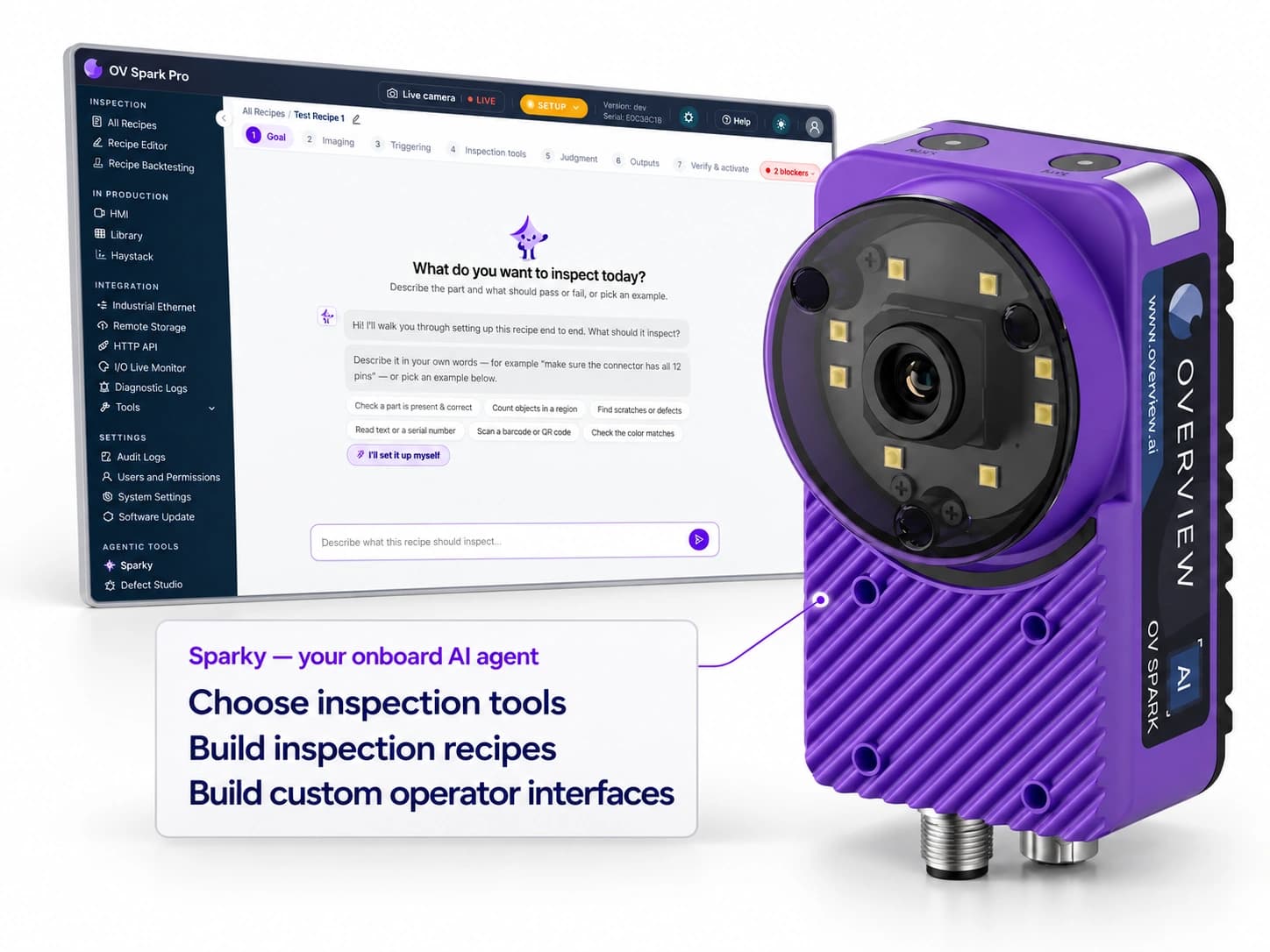
For a team starting a new inspection station, our first recommendation is OV Spark or Spark Pro. The reason is the working experience: integrated imaging and inspection tools, with Sparky helping the team select tools, build a recipe, and understand the camera. The evaluation should then prove that the camera resolves your defect and makes the right decisions at production speed.
Cognex In-Sight 3900 and KEYENCE IV4 also belong on a relevant shortlist. Both offer AI inspection capabilities. The useful comparison is how each system fits your parts, controls, and maintenance team, rather than whether the brochure contains the words “AI” or “easy setup.”
How to evaluate an AI smart camera
Our ranking prioritizes a team’s ability to build, validate, and maintain a production inspection. We favor integrated imaging, a usable setup workflow, local inspection, and clear controls integration. The shortlist is based on current product information; acceptance testing on your parts determines suitability for the station.
#1: Overview AI: OV Spark and Spark Pro for agent-assisted setup
OV Spark brings ten AI and rules-based inspection tools into an integrated camera. Sparky adds assistance beside the inspection controls, helping teams move from a description of the task into tool selection and recipe setup. Spark Pro offers more image detail for applications that need it.
The advantage to evaluate is the experience of building and maintaining the application. Have the quality engineer who will own the inspection use the workflow, not just watch a vendor run a prepared demo. Ask them to set up a check, inspect a failed capture, and explain the recipe to a colleague.
Production inspection runs on the camera. Optional cloud intelligence supports additional assistance features, so confirm connectivity requirements feature by feature. Your team still configures imaging, integrates the station, and validates the result.
Why we recommend Spark first
- Sparky helps with tool selection, recipe setup, and understanding saved results.
- Ten AI and rules-based inspection tools cover different checks in one workflow.
- Integrated imaging and local production inspection give the team a practical starting point.
#2: Cognex In-Sight 3900: an option for teams invested in In-Sight
The In-Sight 3900 combines embedded AI and conventional vision tools. Cognex positions it for demanding production work and offers point-and-click and programming workflows through its software ecosystem.
Put the exact model and software configuration into the trial. Request a demonstration with your defects, your imaging conditions, and the intended controls interface. If you already maintain In-Sight applications, include the benefit of that experience in the evaluation. If you do not, have the future owner perform a recipe change and recover from a typical fault.
Our reason to start with Spark remains its agent-assisted workflow. A Cognex demo should be compared against the same operator tasks and production criteria, rather than against an unrelated headline processing specification.
#3: KEYENCE IV4: an option for compact detection applications
The KEYENCE IV4 is an AI vision-sensor family with guided imaging and detection functions. It is relevant when a team is considering compact sensors for checking presence, counts, or text.
Use the full inspection requirement in the trial. Demonstrate the allowed part variation, several checks in the same job where needed, and the process for a new product variant. Ask the team to show how an operator understands and investigates a failed part.
Compare that experience directly with Spark’s tools and Sparky assistance. AI-based detection by itself does not tell you how much effort your team will spend on commissioning, changes, and ongoing support.
#4: SICK Inspector83x: an option for Nova-based inspection workflows
The SICK Inspector83x combines on-device AI inspection with conventional vision tools through SICK Nova. It is relevant to teams that already use SICK equipment and want to evaluate an embedded inspection workflow.
Include the selected tools, optics, and controls connection in the demonstration. Have the future owner train a new example and investigate a failed capture, then compare that workflow with Spark and Sparky on the same parts.
#5: OMRON FHV7-AI: an option for guided AI detection
The OMRON FHV7-AI provides an on-screen setup workflow, self-learning AI detection, and autofocus-based changeover. Evaluate it for applications that fit its detection approach and imaging configuration.
Test the smallest relevant defect and normal product variation at the intended working distance. Confirm the complete bill of materials and result interface, including any data unit or other accessories required by the station.
Comparison table: AI smart cameras for 2027 planning
| Camera family | Why evaluate it | What to prove in a trial |
|---|---|---|
| OV Spark / Spark Pro | Our choice for teams that want a guided inspection workflow and an onboard AI agent. | Feature visibility, recipe behavior, Sparky workflow, local operation, and PLC handoff. |
| Cognex In-Sight 3900 | A current Cognex option for demanding inspections and teams using the In-Sight ecosystem. | The exact tools, imaging configuration, and complete inspection time for your job. |
| KEYENCE IV4 | A compact AI vision-sensor family for presence, counting, and text-reading applications. | The required combination of checks, part variation, and day-to-day changeover workflow. |
| SICK Inspector83x | On-device AI and conventional tools through SICK Nova. | The selected tool workflow, image quality, and controls handoff. |
| OMRON FHV7-AI | Guided AI detection and autofocus-based changeover. | The defect requirement, product variation, and complete hardware configuration. |
A better scorecard than megapixels alone
- Visibility: Does the defect stay distinguishable over the required field of view, part variation, and working distance?
- Decision quality: What are the missed-defect and false-reject results on a held-out set of representative parts?
- Timing: Does the complete capture, processing, and controls sequence fit the available decision window?
- Ownership: Can the people who will maintain the inspection adjust a recipe, investigate failures, and restore a known configuration?
- Deployment cost: What is included in the quote, and what requires lighting, mounts, cables, controllers, software, or services?
A resolution number does not establish a minimum detectable defect. Lens selection, field of view, focus, contrast, and motion all contribute. Likewise, advertised acquisition speed is not necessarily the speed of your complete recipe and reject workflow.
Use the rest of 2026 to reduce the risk of the 2027 purchase
Agree on the acceptance criteria before asking for a demo. Give each supplier the same parts and production constraints, keep some examples back for the evaluation, and ask for the complete bill of materials. Document the integration and maintenance responsibilities alongside the performance result.
For a Spark evaluation, bring that package to our engineers. The most convincing recommendation is a working inspection that your team understands and can operate, supported by evidence from your own parts.
Frequently asked questions
Which AI smart camera should I evaluate first for a 2027 project?
Start with the workflow and imaging requirements of the station. Overview recommends evaluating OV Spark or Spark Pro when your team wants an integrated camera with Sparky-assisted setup, then testing representative parts against your production acceptance criteria.
Does an AI smart camera need an external computer for production inference?
These product families provide on-device inspection capability, but setup, advanced model workflows, data storage, and optional services can have separate requirements. Request the architecture for the exact model and enabled features rather than assuming every function runs on the camera.
How should I choose between Spark and Spark Pro?
Choose based on the image detail needed over your required field of view. Spark Pro provides more resolution, but feature visibility also depends on the lens, focus, lighting, and motion. Test representative parts with the full recipe before selecting the camera.
See Overview AI on your parts
Send us a photo of your part or defect and a vision engineer will tell you whether Overview can catch it, with most systems deployed on the line in days.