Chinese OEMs Are Winning on Manufacturing Cost - And the Data Shows Exactly Why
(And what it means for the rest of the industry.)
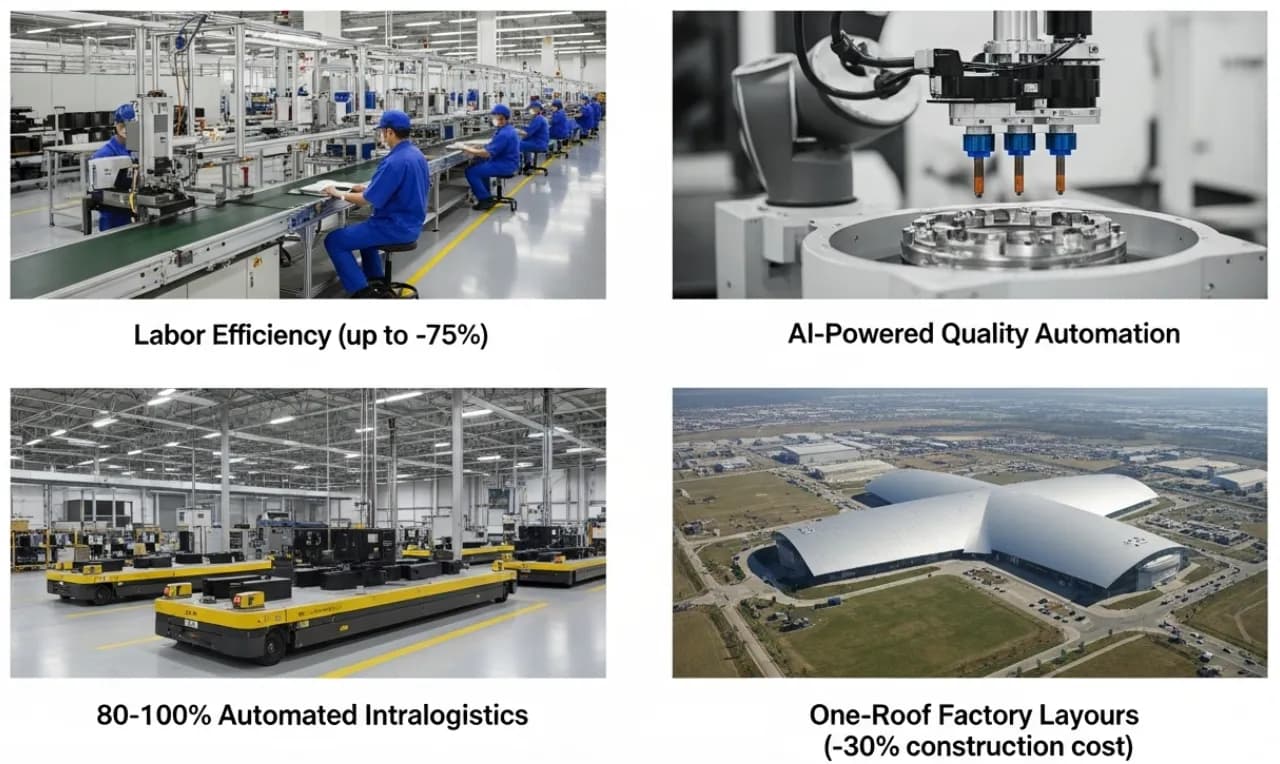
BCG's latest global automotive manufacturing study is one of the clearest explanations yet of why Chinese OEMs now enjoy a 20–75% cost advantage across production. While much of the public conversation centers on labor costs and incentives, the report shows that the real advantage comes from automation, factory design, and a different approach to engineering and operations.
At Overview.ai, we spend every week in EV plants, sensor-module factories, aerospace lines, and contract manufacturers across the U.S., Mexico, and Europe. What we're seeing on the ground aligns almost perfectly with this study-and helps explain why automation-led approaches are outperforming traditional manufacturing models.
Below are the key insights we pulled from the BCG analysis, combined with real deployment observations from our customers.
Key Insights from BCG's Study
1. Labor Efficiency is a Massive Lever
BCG shows up to 75% lower direct and indirect labor cost at Chinese OEMs - not just because of wage arbitrage, but because they've eliminated an enormous amount of manual work across quality, intralogistics, and assembly.
This aligns with what our customers see: When inspection is fully automated with AI vision, assembly and testing labor drops fast - and stays low.
2. Quality Automation is a Quiet Superpower
The study highlights automated quality control using cameras and AI reducing quality cost by ~20% at Chinese OEMs. This tracks closely with what we observe in the field:
- 5–6 sample training is now normal
- Vision models can detect low-contrast defects legacy cameras miss
- Automation teams can reconfigure inspections in minutes, not weeks
Quality is no longer a labor function - it's a software loop.
3. Intralogistics Automation is Insanely Far Ahead
Chinese plants are hitting 80–100% automation in intralogistics vs ~20% in the West. That level of automation only works when perception is reliable across:
- Varying angles
- Inconsistent lighting
- Part variability
- Mixed materials/finishes
This is exactly why we see robotics teams (assembly + kitting + material flow) pushing for high-precision vision paired with robust, low-sample AI.
4. "One-Roof Factories" are a Structural Cost Cheat Code
One of our favorite visuals in the report is the side-by-side of VW Zwickau vs Tesla Austin.
BCG notes: up to 30% lower construction cost and simpler flows when everything lives under a single roof.
But here's the hidden detail: One-roof only works if every step is software-instrumented.
Material flow, quality, assembly, predictive maintenance - all rely on clean data inputs, and vision is a major one.
You can't centralize chaos. You can centralize data.
Recommendations for Western Manufacturers
While BCG outlines fourteen structural levers for reducing manufacturing cost, only a handful directly accelerate automation, reduce touch labor, and improve day-to-day reliability on the factory floor. These are the moves that matter most for teams modernizing quality, intralogistics, and assembly operations.
Here are five recommendations grounded in the data from the study and validated by what we see across the EV, aerospace, and high-reliability electronics factories we support.
1. Fully Automate Quality Control With AI Vision
Quality is one of the highest-ROI automation targets. Plants using AI vision consistently reduce escapes, eliminate shift-to-shift variability, and close out entire categories of manual inspection.
The shift is simple: quality moves from a person-dependent activity to a software loop.
Where to start: Upgrade the 3–5 inspection points that drive the most rework or slowdowns. With modern AI systems, you can train models in minutes using as few as 5–6 images per defect type.
2. Deploy AGVs and Stabilize Them With Reliable Perception
AGVs can deliver huge labor savings-but only when part quality, orientation, and upstream flow are consistent. Many Western plants see AGVs stall or misroute not because of robotics, but because of unstable perception signals.
AI vision fixes that by making sure the right part is in the right condition at the right time.
Where to start: Instrument high-traffic transfer points and pack-in/line-feed lanes with AI vision to validate parts before AGVs pick them up.
3. Optimize Material Flow With Vision-Assisted Autonomy
Material flow breaks down when the variability of incoming parts overwhelms automation. Vision reduces that variability by:
- Checking orientation
- Detecting mix-ups
- Highlighting upstream quality issues
- Verifying correct assemblies
When flow is stabilized, automation compounds-and cycle times fall.
Where to start: Add vision checkpoints to the chokepoints of your flow (pre-assembly, induction, subassembly build-ups) before redesigning conveyors or deploying more AGVs.
4. Use Vision Insights to Drive Design-for-Assembly Improvements
Chinese OEMs aggressively reduce part counts and complexity to lower touch labor. One overlooked advantage of modern AI vision is that the inspection data itself becomes an input to engineering.
Defect clusters, misalignment patterns, and variability trends show exactly where designs introduce friction downstream.
Where to start: Feed vision-based defect heatmaps back to engineering to simplify architectures and eliminate recurring sources of failure.
5. Commission Machinery In-House With Vision-Based Validation
In-house commissioning cuts machinery cost and accelerates ramp-up, but only works when you can validate accuracy, drift, and reliability without waiting on vendors.
Vision is the fastest way to build that internal capability-acting as a precise, objective measurement layer for robots, fixtures, and automated lines.
Where to start: Establish a small commissioning cell with AI vision for calibration, tolerance checks, and early fault detection.
Where Overview.ai Fits In
The operators winning globally are the ones turning physical processes into software loops-and AI-powered vision is one of the fastest ways to get there.
Automation doesn't start with robots. It starts with seeing.
And that's exactly where Overview.ai focuses:
- 5–6 image training for rapid deployment
- Automatic detection of unseen defects through robust generalization
- Orientation- and lighting-independent models that hold up across real production variation
- Browser-based deployment in minutes
- Full system setup in hours, not weeks or quarters
The manufacturers who invest in vision early are the ones who unlock the rest of the automation stack-reliable AGVs, stable robotics, simplified assembly, and faster commissioning.
Key Takeaways:
- • Chinese OEMs achieve 20-75% cost advantages through systematic automation, not just labor costs
- • AI-powered quality control reduces quality costs by ~20% while eliminating manual inspection variability
- • 80-100% intralogistics automation requires reliable vision systems that handle real-world variation
- • "One-roof factories" only work when every process is software-instrumented with clean data inputs
- • Western manufacturers can close the gap by prioritizing vision-led automation in quality, flow, and assembly
Ready to Close the Manufacturing Cost Gap?
Learn how AI-powered vision systems can transform your quality control and accelerate the rest of your automation stack.
Frequently Asked Questions
How much of Chinese OEMs' cost advantage comes from labor versus automation?
BCG's analysis shows up to 75% lower direct and indirect labor cost at Chinese OEMs, but wage arbitrage is only part of the picture. A substantial portion comes from eliminating manual work through automation in quality control, intralogistics, and assembly, areas where Western plants still rely heavily on human operators.
What role does AI vision play in intralogistics automation?
Reliable AI vision is a prerequisite for high levels of intralogistics automation. AGVs and robotic material handling systems require consistent perception to handle varying part orientations, lighting, and materials. Without accurate vision at key transfer points, automation rates stall and misroutes increase.
Where should a Western manufacturer start with AI-led automation?
Automating quality inspection is the highest-ROI starting point because it directly reduces escapes, eliminates shift-to-shift variability, and generates data that improves downstream processes. Modern AI vision systems can be deployed at the highest-value inspection points in days, not quarters.
How does automated quality inspection reduce manufacturing cost?
BCG estimates automated quality control reduces quality-related costs by approximately 20% at Chinese OEMs. The savings come from lower inspection labor, fewer customer escapes that drive costly warranty and rework activity, and faster identification of upstream process drift before it creates large batches of scrap.
See how Overview AI inspects manufacturing quality control
Send us a photo of your part or defect and a vision engineer will tell you whether Overview can catch it, with most systems deployed on the line in days.
Related Articles
ROI of Computer Vision in Manufacturing
A framework for calculating cost savings and productivity gains from AI vision inspection.
Read More →AI in Manufacturing Quality Control
How AI vision systems replace manual inspection and reduce defect escapes.
Read More →Factory Automation Vision Systems
A guide to deploying vision systems across automated production lines.
Read More →