Complete Guide to AI-Powered SPC in 2026
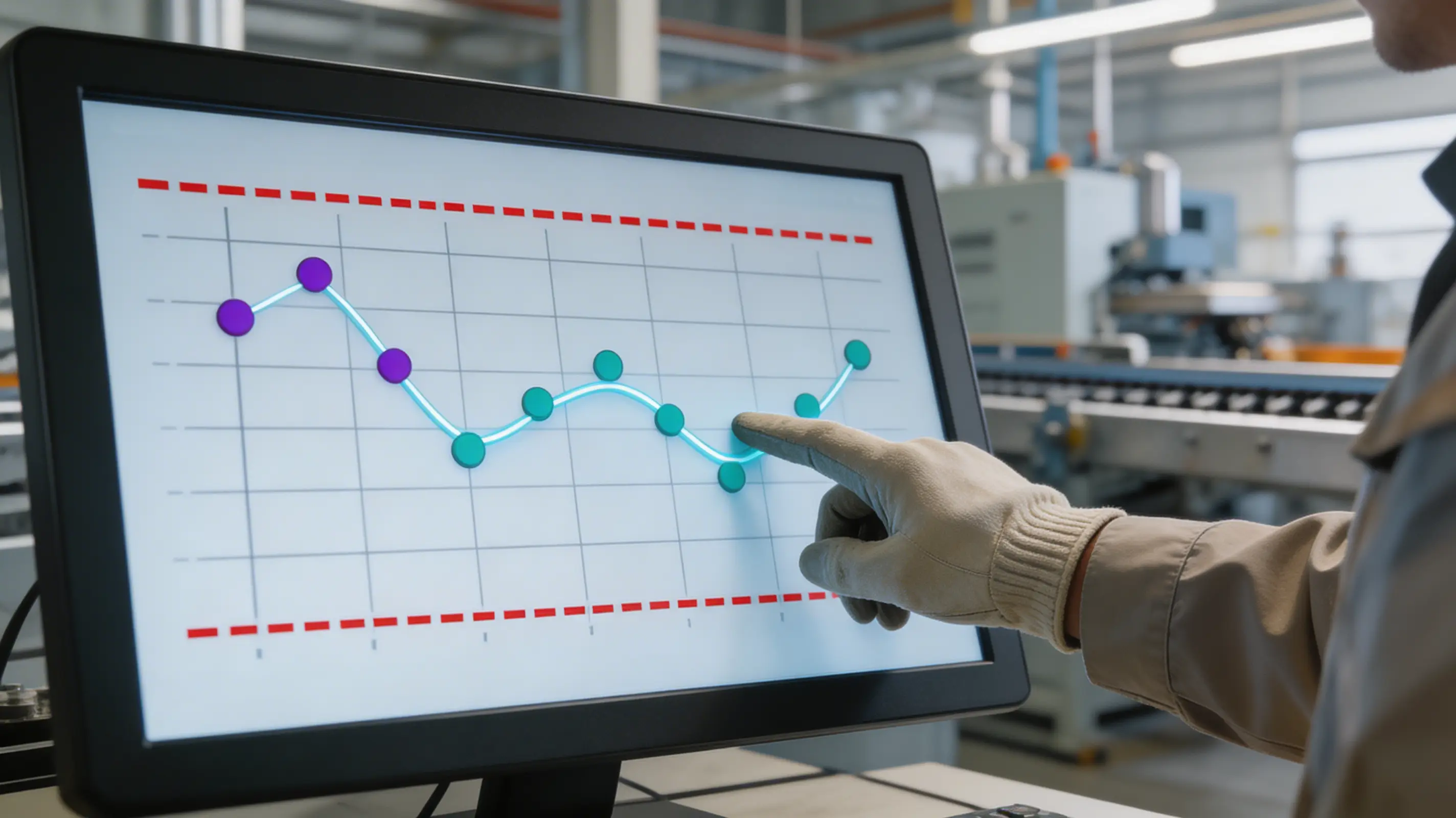
Statistical Process Control has been a quality management staple since the 1920s. But traditional SPC, manual sampling, univariate control charts, and delayed reactions, can't keep up with today's manufacturing speed and complexity. In 2026, AI is transforming SPC from a reactive reporting tool into a real-time, predictive quality engine. Here's everything you need to know.
Traditional SPC vs. AI-Powered SPC
| Dimension | Traditional SPC | AI-Powered SPC (2026) |
|---|---|---|
| Sampling | Periodic (1-in-20 parts) | 100% inspection, real-time |
| Variables monitored | 1–3 per chart | Hundreds simultaneously (multivariate) |
| Pattern detection | Manual (Western Electric rules) | Automated ML pattern recognition |
| Response time | Hours to days | Seconds to minutes |
| Root cause | Manual investigation | AI-suggested top causes |
| Action | Operator-initiated | Automated or operator-assisted |
5 Ways AI Upgrades SPC
Multivariate Process Monitoring
Traditional control charts track one variable at a time. AI-SPC monitors hundreds of process variables simultaneously, detecting complex multi-variable drift patterns that no single chart would catch. For example, a slight temperature increase combined with a minor pressure drop and a new material lot might individually be within limits, but together they predict a quality escape.
Early Drift Detection
ML algorithms detect subtle process shifts 2–5× earlier than standard Western Electric rules. Instead of waiting for a point to cross a control limit, AI recognises the pattern of an emerging trend, giving engineers time to intervene before a single defective part is produced.
Automated Root Cause Suggestions
When AI-SPC detects an anomaly, it correlates the shift with upstream variables to suggest the most likely root causes. Instead of "X-bar chart out of control at 14:32," engineers get "Temperature on Zone 3 drifted +2.1°C at 14:15, 85% correlated with the dimensional shift detected at 14:32."
Visual SPC, Image Data as a Process Variable
AI inspection platforms like Overview AI add a new dimension to SPC: visual data. Defect rates, defect type distributions, and severity scores from AI inspection become SPC variables, enabling control charts on quality attributes that were previously unquantifiable.
Closed-Loop Corrective Action
The most advanced AI-SPC systems don't just detect and alert, they close the loop. When a drift is detected, the system automatically adjusts the relevant process parameter (with configurable guardrails) or generates a corrective action ticket with pre-populated root cause analysis.
How to Implement AI-Powered SPC
Step 1: Audit your data
Inventory all process variables, sensor feeds, and quality data sources. AI-SPC is only as good as the data it receives. Identify gaps and prioritise sensors/data connections.
Step 2: Start with one critical process
Don't boil the ocean. Pick the process with the highest scrap rate or most customer complaints and implement AI-SPC there first.
Step 3: Integrate visual inspection data
If you're running AI vision inspection (e.g., Overview AI), feed defect classification data directly into your SPC system as a real-time quality variable.
Step 4: Define escalation rules
Configure what happens when AI-SPC detects a shift: alert only, alert + suggested action, or automatic adjustment. Start conservative and increase autonomy over time.
Step 5: Train operators on the new workflow
AI-SPC changes the operator's role from "check the chart" to "respond to intelligent alerts." Train teams on the new interface and escalation procedures.
Step 6: Expand and refine
Roll out to additional processes, tune alert sensitivity based on production experience, and continuously add new data sources.
AI-SPC Tools to Consider
| Platform | Strength | Best For |
|---|---|---|
| Overview AI | Visual SPC, image-level defect trends as quality variables | Adding visual quality data to process monitoring |
| Hexagon Q-DAS | Industry-standard dimensional SPC with AI augmentation | Precision manufacturing, automotive |
| SAS Viya | Enterprise-grade multivariate analysis with regulatory compliance | Pharma, medical devices |
| Sight Machine | Process-quality correlation across entire data streams | High-volume process manufacturing |
| InfinityQS Enact | Cloud SPC with real-time alerting and cross-site dashboards | Multi-site quality standardisation |
Related Reading
Add Visual Intelligence to Your SPC
Overview AI turns every inspection point into a visual SPC data source, tracking defect trends, severity distributions, and model confidence in real time.
Schedule a DemoFrequently Asked Questions
What is AI-powered SPC?
AI-powered SPC extends traditional Statistical Process Control by applying machine learning to process and quality data. Instead of manually monitoring one variable at a time on a control chart, AI-SPC monitors hundreds of variables simultaneously, detects drift patterns earlier than standard Western Electric rules, and suggests likely root causes when anomalies are detected.
How does AI-SPC differ from traditional SPC?
Traditional SPC relies on periodic sampling, univariate control charts, and manual investigation. AI-SPC enables 100% inspection coverage in real time, monitors multivariate patterns, and can automate corrective action suggestions or parameter adjustments. Response times shrink from hours or days to seconds or minutes.
Can visual inspection data be used in SPC?
Yes. AI inspection platforms like Overview AI output defect rates, defect type distributions, and severity scores that can be fed directly into SPC systems as real-time quality variables. This adds a visual quality dimension to process monitoring that was previously unquantifiable.
What is the first step to implementing AI-powered SPC?
Start with a data audit. Inventory all process variables, sensor feeds, and quality data sources available in your facility. AI-SPC depends entirely on the data it receives, so identifying gaps before implementation prevents building a system on incomplete inputs. Then pick one high-impact process to pilot before expanding.
See how Overview AI inspects statistical process control
Send us a photo of your part or defect and a vision engineer will tell you whether Overview can catch it, with most systems deployed on the line in days.
Related Articles
AI in Manufacturing Quality Control
How AI vision systems fit into the broader quality control workflow in modern manufacturing.
Read More →Achieving 100% Accuracy with AI Vision
What it takes to reach near-perfect inspection accuracy with AI vision systems.
Read More →Automated Quality Inspection with AI
An overview of how automated AI inspection replaces or supplements manual quality checks.
Read More →