Global shutter vs rolling shutter: which one inspection needs
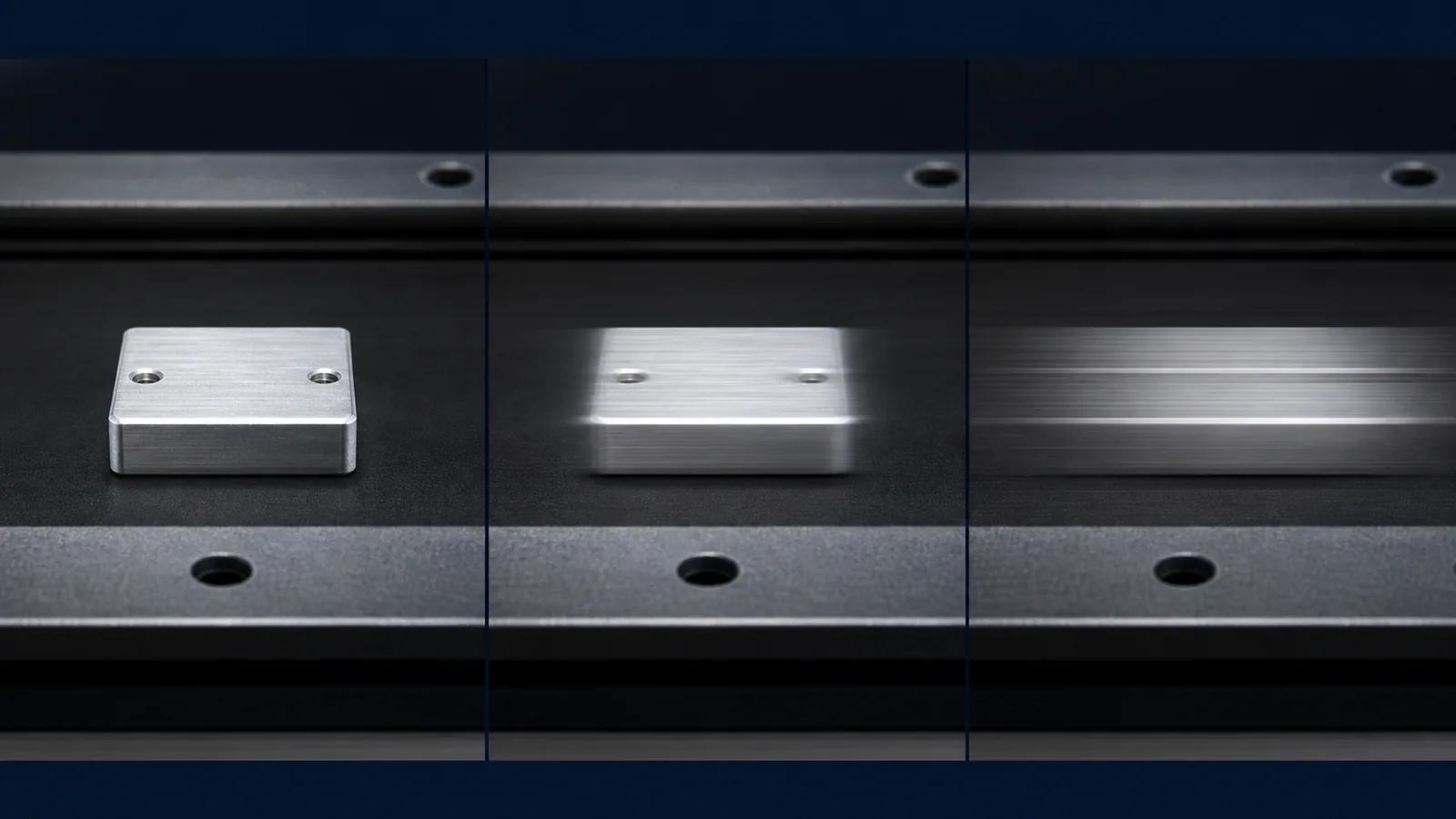
Shutter type is one line on a datasheet that quietly decides whether an inspection works. It is not a quality ranking, and the more expensive sensor is often the rolling one. It is a question about whether your part is moving when the picture is taken.
The mechanical difference
Global shutter
Every pixel on the sensor starts and stops collecting light at the same instant. The frame is a single snapshot in time, so whatever the part was doing, all of it was doing the same thing at the same moment.
Rolling shutter
The sensor is read row by row, top to bottom. The bottom of the frame is captured a fraction of a second after the top. On a still part that is irrelevant. On a moving one, each row sees the part in a slightly different place.
That row delay is the entire story. It produces skew: a part travelling across the field of view is recorded leaning, because by the time the sensor reached the bottom rows the part had moved. A rectangle becomes a parallelogram, a circular hole becomes an ellipse, and a straight edge becomes a slanted one.
This matters more than it sounds. Skew is not noise that averages out. It is a systematic geometric error whose size depends on how fast the part was moving, which means the same part measures differently at different line speeds.
Rolling shutter is not the same problem as motion blur
These get conflated constantly, and the fix for one does not fix the other.
Motion blur
The part moved during a single exposure, so its edges smear. Both shutter types suffer from it. The fix is a shorter exposure, which means more light.
Rolling shutter skew
The part moved between the top and bottom rows being read. Only rolling shutters suffer from it. A shorter exposure does not fix it, because the readout still takes as long as it takes. Each row can be perfectly sharp and the frame still be geometrically wrong.
So on a moving line you have two separate problems to solve. Exposure handles blur. Shutter type, or a strobe, handles skew.
The strobe exception
A rolling shutter can be made to behave like a global one, and the trick is to control the light instead of the sensor. Open the shutter in a dark enclosure, fire a very short high-intensity flash, then finish the readout. The part is only illuminated for the duration of the flash, so every row records the same instant regardless of when it was read.
This works well and is common. It has conditions attached:
- The station has to be dark enough that ambient light contributes nothing during readout, which usually means enclosing it.
- You need a strobe controller and a light capable of the intensity, so the lighting is no longer a simple always-on ring.
- The flash has to be synchronised to the trigger and the readout, which is one more thing to commission and one more thing that can drift.
As a rough guide, our own cameras illustrate the tradeoff: the OV80i runs a rolling shutter at 16 ms exposure without a strobe, and about 10 microseconds with one. That is three orders of magnitude, and it is the difference between a sensor that cannot inspect a moving part and one that can.
How to decide
Answer one question first: is the part moving at the moment of capture?
| Situation | Choose |
|---|---|
| Part indexes and stops in front of the camera | Either. Shutter type stops mattering when nothing moves, so choose on resolution instead. |
| Part moves continuously on a conveyor | Global shutter, or rolling with a strobe in an enclosed station. |
| You are reporting a dimension on a moving part | Global shutter. Skew is measurement error and it scales with line speed. |
| Camera is on a robot arm | Global shutter, unless the arm fully settles before capture. |
| Continuous web, roll, or sheet | Global shutter, or a line scan camera, which sidesteps the question by design. |
| You need very high resolution and the part can be stopped | Rolling shutter is reasonable. High-resolution sensors are often rolling, and stopping the part removes the drawback. |
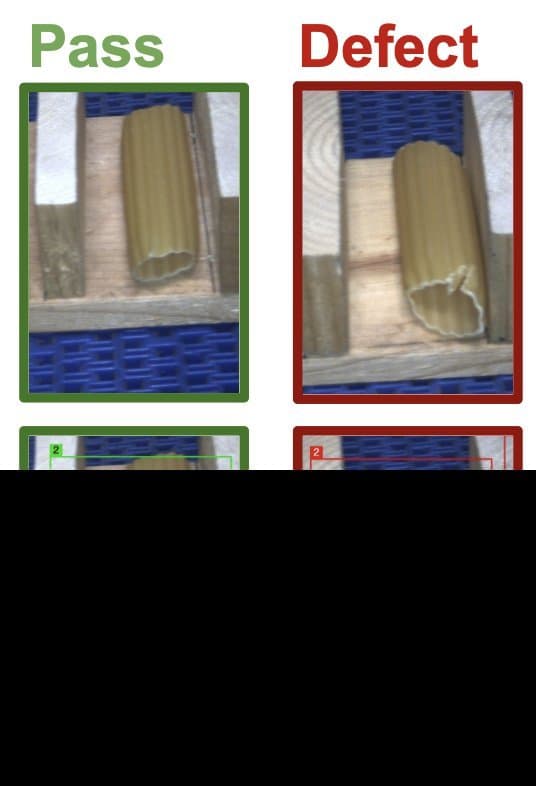
A worked case. Cracks in pasta on a moving conveyor is continuous motion, an organic shape, and a fine defect. That combination wants a global shutter, because skew on an irregular product is impossible to distinguish from the product genuinely being irregular. Our own deployment on that application used the OV20i, which is global shutter.
What to check on a datasheet
- Shutter type stated plainly. If it is not stated, assume rolling, because global is the feature a vendor advertises.
- Minimum exposure time, with and without a strobe if the sensor is rolling. The gap between those two numbers tells you how much the strobe is doing.
- Whether a hardware trigger input exists. Software timing drifts, and on a fast line the drift is the whole defect.
- Frame rate with room to spare over your line rate, including the time to decide and act, not just to capture.
Our optics calculators include a maximum part speed calculator that takes your motion blur tolerance and the exposure time available, with and without a strobe, and returns the fastest the line can run while keeping the image usable. The industrial camera guide covers the rest of the sensor decision, and lighting is inseparable from this one, so our piece on machine vision lighting is worth reading alongside it. For the whole station rather than the camera, see machine vision systems.
Frequently Asked Questions
What is the difference between a global shutter and a rolling shutter?
A global shutter exposes every pixel on the sensor at the same instant, so the frame is a single snapshot in time. A rolling shutter reads the sensor row by row, so the bottom of the image is captured slightly later than the top. On a stationary part the difference is irrelevant. On a moving part the row delay records each row with the part in a different position, which skews the geometry of the image.
Why does a rolling shutter distort moving parts?
Because the part keeps moving while the sensor is being read from top to bottom. By the time the lower rows are read the part has advanced, so a rectangle records as a parallelogram, a round hole records as an ellipse, and a straight edge records as slanted. The size of the error scales with how fast the part is moving, which means the same part measures differently at different line speeds.
Is rolling shutter skew the same as motion blur?
No, and they need different fixes. Motion blur is smearing because the part moved during a single exposure, it affects both shutter types, and a shorter exposure fixes it. Rolling shutter skew is geometric distortion because the part moved between the first and last rows being read. A shorter exposure does not fix skew, since the readout still takes as long as it takes. Every row can be perfectly sharp and the frame still be the wrong shape.
Can a strobe make a rolling shutter work on a moving line?
Yes, and it is a common approach. In an enclosed dark station, a very short high-intensity flash illuminates the part for a fraction of the readout, so every row records the same instant regardless of when it was read. The conditions are that ambient light must contribute nothing during readout, you need a strobe controller and a light capable of the intensity, and the flash has to be synchronised to the trigger. As an indication of scale, a rolling-shutter sensor might need 16 ms exposure without a strobe and around 10 microseconds with one.
Which shutter type should I use for inspection?
If the part indexes and stops in front of the camera, either works and you should choose on resolution instead. If the part moves continuously, if you are reporting a dimension on a moving part, if the camera is on a robot arm, or if you are inspecting a continuous web, use a global shutter or a rolling shutter with a strobe in an enclosed station. Rolling shutter is reasonable when you need very high resolution and can stop the part, since high-resolution sensors are frequently rolling.
Do I always need a global shutter for factory inspection?
No, but most factory subjects are moving, so global shutter is the safer default. The question that decides it is whether the part is moving at the moment of capture, not whether the application is industrial. A part on an indexing fixture that comes to a complete stop removes the concern entirely.
See how Overview AI inspects high-speed inspection
Send us a photo of your part or defect and a vision engineer will tell you whether Overview can catch it, with most systems deployed on the line in days.
Related Articles
Machine Vision Lighting
Lighting and exposure are one decision, and lighting caps the speed you can inspect.
Read More →Telecentric Lenses in Machine Vision
The other geometric error in an inspection image, and when it is worth paying to remove.
Read More →Industrial Camera Selection for AI Inspection
Where shutter type sits among the specs that actually decide the outcome.
Read More →